Configuration¶
repomatic reads two kinds of pyproject.toml configuration. Its own settings live in [tool.repomatic], documented below. The third-party tools it runs are configured through their own standard [tool.*] sections ([tool.ruff], [tool.mypy], [tool.typos], [tool.nuitka], and so on); repomatic discovers and resolves these through its tool runner, where they are documented.
[tool.repomatic] configuration¶
Downstream projects can customize workflow behavior by adding a [tool.repomatic] section in their pyproject.toml. These options control the defaults for the corresponding CLI commands.
The [tool.repomatic] section is powered by Click Extra’s pyproject.toml configuration. Click Extra handles CWD-first discovery (walking up to the VCS root), key normalization (kebab-case to snake_case), and typed dataclass schemas (nested sub-tables, opaque dict fields, strict validation).
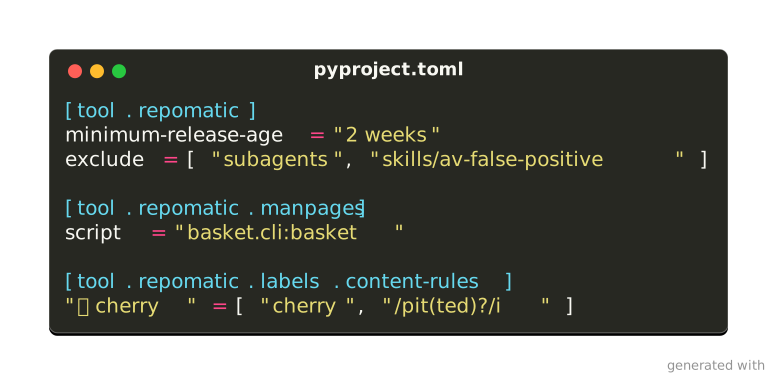
[tool.repomatic]
pypi-package-history = ["old-name", "older-name"]

awesome-template.sync = false
binaries.sync = false
bumpversion.sync = false
cache.max-age = 14
debug.sync = true
dep-sources.sync = false
dev-release.sync = false
gitignore.sync = false
labels.sync = false
mailmap.sync = false
setup-guide = false
sphinx.builder = "dirhtml"
site.deploy = "cloudflare-pages"
site.cloudflare-project = "my-legacy-project-name"
site.cloudflare-compatibility-date = "2026-06-16"
site.cloudflare-placement = "smart"
site.cloudflare-r2-bucket = "my-site-files"
site.cloudflare-r2-domain = "files.example.com"
uv-lock.sync = false

dependency-graph.update = true
dependency-graph.output = "./docs/assets/dependencies.mmd"
dependency-graph.all-groups = true
dependency-graph.all-extras = true
dependency-graph.no-groups = []
dependency-graph.no-extras = []
dependency-graph.level = 0

metrics.sync = true
metrics.store = "./docs/assets/metrics.csv"

gitignore.location = "./.gitignore"
gitignore.extra-categories = ["terraform", "go"]
gitignore.extra-content = '''
# Claude Code
.claude/
'''

exclude = ["skills", "workflows/autolock.yaml", "mypy"]

flavor.agent = "claude_code"
flavor.ci = "github_ci"

labels.extra-files = ["https://example.com/my-labels.toml"]

nuitka.dev-targets = ["linux-arm64", "windows-x64"]
nuitka.enabled = false
nuitka.entry-points = ["mpm"]
nuitka.nofollow-imports = []
nuitka.unstable-targets = ["linux-arm64", "windows-arm64"]

workflow.sync = false
workflow.source-paths = ["extra_platforms"]
workflow.extra-paths = ["install.sh", "dotfiles/**"]
workflow.ignore-paths = ["uv.lock"]

[tool.repomatic.labels.file-rules]
"📚 docs" = ["docs/**", "!docs/generated/**"]

[tool.repomatic.labels.content-rules]
"🛡️ security" = ["CVE", "vulnerability"]

[tool.repomatic.workflow.paths]
"tests.yaml" = ["install.sh", "packages.toml", ".github/workflows/tests.yaml"]
abandoned-versions¶
Versions documented in the changelog but never published.
Type: list[str] | Default: []
A version reached only its [changelog] Release vX.Y.Z freeze and was then
skipped (botched build, broken artifact, bad metadata) without rewriting
history: the next release took its place. List those versions here
so lint-changelog reports them as skipped (an info log line) instead of
flagging them every run as ⚠ X.Y.Z: not found on PyPI. Applies to both
PyPI lookups and the git-tag fallback.
Example:
[tool.repomatic]
abandoned-versions = []
action-pins.sync¶
Whether the sync-action-pins job is enabled for this project.
Type: bool | Default: true
Bumps SHA-pinned GitHub Actions (uses: owner/repo@<sha> # vX.Y.Z) to the
latest release passing the minimum-release-age cooldown. Projects that
pin actions by hand can set this to false.
Example:
[tool.repomatic]
action-pins.sync = true
awesome-template.sync¶
Whether awesome-template sync is enabled for this project.
Type: bool | Default: true
Repositories whose name starts with awesome- get their boilerplate synced
from files bundled in repomatic. Set to false to opt out.
Example:
[tool.repomatic]
awesome-template.sync = true
binaries.sync¶
Whether the release pipeline records released binaries into the repository.
Type: bool | Default: true
When enabled, the scan-virustotal release job regenerates the binaries
catalog (docs/binaries.md and docs/assets/binaries.csv) and publishes
it, along with the scan history (docs/assets/virustotal-scans.csv),
through one long-lived pull request that each release appends to: the
contract documented in
docs/operation-contracts.md.
Set to false to keep the repository untouched: binaries are still
scanned on VirusTotal (seeding AV vendor databases), but no catalog page,
CSV, or scan record is published.
Example:
[tool.repomatic]
binaries.sync = true
bumpversion.sync¶
Whether bumpversion config sync is enabled for this project.
Type: bool | Default: true
Projects that manage their own [tool.bumpversion] section and do not want
the autofix job to overwrite it can set this to false.
Example:
[tool.repomatic]
bumpversion.sync = true
cache.dir¶
Override the binary cache directory path.
Type: str | Default: ""
When empty (the default), the cache uses the platform convention:
~/Library/Caches/repomatic on macOS, $XDG_CACHE_HOME/repomatic
or ~/.cache/repomatic on Linux, %LOCALAPPDATA%\repomatic\Cache
on Windows. The REPOMATIC_CACHE_DIR environment variable takes
precedence over this setting.
Example:
[tool.repomatic]
cache.dir = ""
cache.github-release-ttl¶
Freshness TTL for cached single-release bodies (seconds).
Type: int | Default: 604800
GitHub release bodies are immutable once published, so a long TTL (7 days)
is safe. Set to 0 to disable caching for single-release lookups.
Example:
[tool.repomatic]
cache.github-release-ttl = 604800
cache.github-releases-ttl¶
Freshness TTL for cached all-releases responses (seconds).
Type: int | Default: 86400
New releases can appear at any time, so a shorter TTL (24 hours) balances freshness with API savings.
Example:
[tool.repomatic]
cache.github-releases-ttl = 86400
cache.max-age¶
Auto-purge cached entries older than this many days.
Type: int | Default: 30
Set to 0 to disable auto-purge. The REPOMATIC_CACHE_MAX_AGE
environment variable takes precedence over this setting.
Example:
[tool.repomatic]
cache.max-age = 30
cache.npm-ttl¶
Freshness TTL for cached npm registry metadata (seconds).
Type: int | Default: 86400
New npm versions can appear at any time, so a 24-hour TTL balances
freshness with request savings. Set to 0 to disable caching for npm
lookups.
Example:
[tool.repomatic]
cache.npm-ttl = 86400
cache.pypi-ttl¶
Freshness TTL for cached PyPI metadata (seconds).
Type: int | Default: 86400
PyPI metadata changes when new versions are published. A 24-hour TTL avoids redundant API calls while keeping data reasonably current.
Example:
[tool.repomatic]
cache.pypi-ttl = 86400
changelog.archive-location¶
File path of the changelog archive, relative to the root of the repository.
Type: str | Default: ""
The archive holds older release sections split out of the live changelog to keep it small. Empty (the default) disables archive handling.
When set, lint-changelog treats versions documented in the archive as
present, so they are neither reported nor re-inserted as orphans (versions
found on PyPI, GitHub, or git tags but missing from the changelog). The
archive is frozen: its released entries are immutable and are not
re-validated against their canonical release dates.
Example:
[tool.repomatic]
changelog.archive-location = ""
changelog.bullet-word-threshold¶
Word count above which lint-changelog warns about a changelog bullet.
Type: int | Default: 40
A changelog entry is a release note, not a commit message: ideally one
short sentence of 10 to 25 words stating what changed. lint-changelog
emits a non-fatal warning for every bullet in the unreleased section
longer than this many words, nudging verbose, implementation-heavy entries
back toward a user-facing summary. Released sections are immutable and
never flagged. Set to 0 to disable the check.
Example:
[tool.repomatic]
changelog.bullet-word-threshold = 40
changelog.location¶
File path of the changelog, relative to the root of the repository.
Type: str | Default: "./changelog.md"
Example:
[tool.repomatic]
changelog.location = "./changelog.md"
debug.sync¶
Whether the debug.yaml workflow is deployed to this project.
Type: bool | Default: false
Opt-in: the workflow dumps the GitHub contexts and the runner’s host probes across every build target, which answers a question a maintainer asks while chasing a runner difference and nothing else reads. Left on by default it spends a monthly matrix of runners, the scarce macOS and Windows ones included, producing logs nobody opens.
Example:
[tool.repomatic]
debug.sync = false
dep-sources.sync¶
Whether the sync-dep-sources updater is enabled for this project.
Type: bool | Default: true
Swaps a dependency tracked from a git branch back to its released version
once the release named by its .dev version floor ships on PyPI (see
repomatic.deps.dep_sources for the managed idiom). Projects that manage
[tool.uv.sources] overrides by hand can set this to false.
Example:
[tool.repomatic]
dep-sources.sync = true
dependency-graph.all-extras¶
Whether to include all optional extras in the graph.
Type: bool | Default: true
When True, the update-dep-graph command behaves as if
--all-extras was passed.
Example:
[tool.repomatic]
dependency-graph.all-extras = true
dependency-graph.all-groups¶
Whether to include all dependency groups in the graph.
Type: bool | Default: true
When True, the update-dep-graph command behaves as if
--all-groups was passed. Projects that want to exclude development
dependency groups (docs, test, typing) from their published graph can
set this to false.
Example:
[tool.repomatic]
dependency-graph.all-groups = true
dependency-graph.level¶
Maximum depth of the dependency graph.
Type: int | Default: (none)
None means unlimited. 1 = directly-declared deps only, 2 = adds
their deps, etc. Equivalent to --level.
dependency-graph.no-extras¶
Optional extras to exclude from the graph.
Type: list[str] | Default: []
Equivalent to passing --no-extra for each entry. Takes precedence
over dependency-graph.all-extras.
Example:
[tool.repomatic]
dependency-graph.no-extras = []
dependency-graph.no-groups¶
Dependency groups to exclude from the graph.
Type: list[str] | Default: []
Equivalent to passing --no-group for each entry. Takes precedence
over dependency-graph.all-groups.
Example:
[tool.repomatic]
dependency-graph.no-groups = []
dependency-graph.output¶
Path where the dependency graph Mermaid diagram should be written.
Type: str | Default: "./docs/assets/dependencies.mmd"
The dependency graph visualizes the project’s dependency tree in Mermaid format.
Example:
[tool.repomatic]
dependency-graph.output = "./docs/assets/dependencies.mmd"
dependency-graph.update¶
Whether the update-dep-graph command writes the graph.
Type: bool | Default: true
Set to false for a project that keeps no dependency graph: the command
then exits without writing, so the update-dep-graph job opens no pull
request.
Example:
[tool.repomatic]
dependency-graph.update = true
dev-release.sync¶
Whether dev pre-release sync is enabled for this project.
Type: bool | Default: true
Projects that do not want a rolling draft pre-release maintained on
GitHub can set this to false.
Example:
[tool.repomatic]
dev-release.sync = true
docs.apidoc-exclude¶
Glob patterns for modules to exclude from sphinx-apidoc.
Type: list[str] | Default: []
Passed as positional exclude arguments after the source directory
(e.g., ["setup.py", "tests"]).
Example:
[tool.repomatic]
docs.apidoc-exclude = []
docs.apidoc-extra-args¶
Extra arguments appended to the sphinx-apidoc invocation.
Type: list[str] | Default: []
The base flags --no-toc --module-first are always applied.
Use this for project-specific options (e.g., ["--implicit-namespaces"]).
Example:
[tool.repomatic]
docs.apidoc-extra-args = []
docs.update-script¶
Path to a Python script run after sphinx-apidoc to generate dynamic content.
Type: str | Default: "./docs/docs_update.py"
Resolved relative to the repository root. Must reside under the docs/
directory for security. Set to an empty string to disable.
Example:
[tool.repomatic]
docs.update-script = "./docs/docs_update.py"
exclude¶
Additional components and files to exclude from repomatic operations.
Type: list[str] | Default: []
Additive to the default exclusions (agents, labels, skills). Bare
names exclude an entire component (e.g., "workflows"). Qualified
component/identifier entries exclude a specific file within a component
(e.g., "workflows/autolock.yaml", "skills/repomatic-audit",
"labels/labels.toml").
Affects repomatic init, workflow sync, and workflow create.
Explicit CLI positional arguments override this list.
Example:
[tool.repomatic]
exclude = []
flavor.agent¶
AI coding agent whose asset layout the bundled skills and agents target.
Type: str | Default: "claude_code"
Accepts a extra_platforms.ALL_AGENTS trait ID present in
AGENT_LAYOUTS. Hyphens are normalized, so
claude-code works too.
Example:
[tool.repomatic]
flavor.agent = "claude_code"
flavor.ci¶
CI system the bundled workflows target.
Type: str | Default: "github_ci"
Accepts a extra_platforms.ALL_CI trait ID. Only github_ci is
implemented: every bundled workflow is a GitHub Actions workflow, so any
other value is rejected rather than quietly emitting the wrong thing.
Example:
[tool.repomatic]
flavor.ci = "github_ci"
gitignore.extra-categories¶
Additional gitignore template categories to fetch from gitignore.io.
Type: list[str] | Default: []
List of template names (e.g., ["Python", "Node", "Terraform"]) to combine
with the generated .gitignore content.
Example:
[tool.repomatic]
gitignore.extra-categories = []
gitignore.extra-content¶
Content appended at the end of the generated .gitignore file.
Type: str | Default: (see example)
“Appended” describes where the string lands, after the gitignore.io block,
not how a downstream value combines with the default above: setting this key
replaces that default wholesale, so the entries shown there are lost
unless the override repeats them. repomatic.gitignore.orphaned_rules()
catches that for any rule an earlier sync already wrote to disk, but not for
one this repository never materialized, so copy the default and extend it
rather than writing only the new lines. Reach for
extra_categories instead when adding
whole gitignore.io templates: that one is additive.
The .cc-writes entry is the one carrying a **/ prefix, because it is the
one Claude Code does not place at the repository root: the directory is
staged beside whichever working directory the session tracks, so a single
cd into a subtree leaves one there instead. Anchoring it would miss every
copy but the root’s.
Example:
[tool.repomatic]
gitignore.extra-content = '''
# Claude Code local files.
.claude/scheduled_tasks.lock
.claude/settings.local.json
**/.claude/.cc-writes/

# Cloudflare wrangler local state.
.wrangler/

# Sphinx linkcheck output.
docs/_linkcheck/
'''
gitignore.location¶
File path of the .gitignore to update, relative to the root of the repository.
Type: str | Default: "./.gitignore"
Example:
[tool.repomatic]
gitignore.location = "./.gitignore"
gitignore.sync¶
Whether .gitignore sync is enabled for this project.
Type: bool | Default: true
Projects that manage their own .gitignore and do not want the autofix job
to overwrite it can set this to false.
Example:
[tool.repomatic]
gitignore.sync = true
include¶
Components and files to force-include, overriding default exclusions.
Type: list[str] | Default: []
Use this to opt into components that are excluded by default (agents,
labels, skills). Each entry is subtracted from the effective exclude
set (defaults + user exclude) and bypasses RepoScope filtering, so
scope-restricted components (like awesome-only skills or Python-only
publish-pypi-action) are included regardless of repository type.
Qualified entries (component/file) implicitly select the parent
component. Same syntax as exclude.
Example:
[tool.repomatic]
include = []
labels.content-rules¶
Per-label patterns matched against an issue or pull request’s text.
Type: dict[str, list[str]] | Default: {}
The [tool.repomatic.labels.content-rules] table maps each label to the
patterns that apply it, evaluated by apply-labels against the title and
body. Any one pattern matching applies the label:
[tool.repomatic.labels.content-rules]
"🥭 mango" = ["mango", "papaya"]
"🐛 bug" = []
A bare pattern is a literal keyword, matched case-insensitively on word
boundaries; the /regex/flags form passes a regex through instead, with
i, m and s honored. An entry for a label the bundled defaults also
carry replaces the default entry, and an empty list disables it (see
repomatic.labels.DEFAULT_CONTENT_RULES).
labels.extra¶
Inline label definitions applied at sync time under the default profile.
Type: list[dict[str, str | bool | list[str]]] | Default: []
Each entry is a mapping carrying labelmaker’s per-label specification:
name (required), color (single color or multi-color list),
description, create, update, enforce-case, rename-from and
on-rename-clash. A rename-from list renames an existing label in
place, preserving its issue and PR associations. Entries are serialized
into a temporary TOML file as [[profiles.default.labels]] blocks and
applied by labelmaker apply, so no extra-labels/*.toml file needs
committing.
For label sets that need multiple profiles, commit a hand-written file
under extra-labels/ or download one via extra-files instead.
Example:
[tool.repomatic]
labels.extra = []
labels.extra-files¶
URLs of additional label definition files (JSON, JSON5, TOML, or YAML).
Type: list[str] | Default: []
Each URL is downloaded into extra-labels/ and applied separately by
labelmaker. For inline definitions that need no external file, use
extra instead.
Example:
[tool.repomatic]
labels.extra-files = []
labels.file-rules¶
Per-label globs matched against the paths a pull request changes.
Type: dict[str, list[str]] | Default: {}
The [tool.repomatic.labels.file-rules] table maps each label to the
globs that apply it, evaluated by apply-labels against the changed
files. The label applies when any changed file matches the glob set:
[tool.repomatic.labels.file-rules]
"🥭 mango" = ["orchard/**", "!orchard/generated/**"]
Globs follow the minimatch dialect (** crosses directories, {a,b}
expands, a leading dot needs no special casing), and a !-prefixed entry
subtracts from the label’s other globs the way a .gitignore line would.
An entry for a label the bundled defaults also carry replaces the default
entry, and an empty list disables it (see
repomatic.labels.DEFAULT_FILE_RULES).
labels.sync¶
Whether label sync is enabled for this project.
Type: bool | Default: true
Projects that manage their own repository labels and do not want the
labels workflow to overwrite them can set this to false.
Example:
[tool.repomatic]
labels.sync = true
lint-deps.allow¶
Packages that may ship from somewhere other than PyPI, and why.
Type: dict[str, str] | Default: {}
lint-deps blocks a release whose dependencies do not all resolve from
the index its users will install from. A handful of arrangements are
legitimate exceptions: a member of the same monorepo published under its
own name, a private mirror an internal project genuinely targets. Name
each one here, mapped to the reason it is safe:
[tool.repomatic]
lint-deps.allow = { papaya = "monorepo workspace member, published separately" }
A mapping rather than a list, deliberately: the reason is the point. An exemption without one is indistinguishable from a forgotten development shortcut six months later, which is the exact thing this gate exists to catch. The reason renders in the report and in the release PR banner, so an accepted exception stays visible instead of disappearing.
Per-package only, with no global off switch, following
exclude-newer-package: an exemption narrow enough to name is one
somebody weighed. Listing a package does not silence its transitive
dependencies, which stay gated on their own.
lint-deps.comment-word-threshold¶
Word count above which lint-deps warns about a floor comment.
Type: int | Default: 40
A floor comment justifies the version in force: what breaks below it, and
where the project would notice. It is not a running log of every earlier
floor, which is what it turns into when each bump appends a paragraph and
deletes nothing. lint-deps emits a non-fatal warning for every comment
longer than this many words. Set to 0 to disable the check.
It starts at the same 40 words as changelog.bullet-word-threshold, and
stays an independent knob: both cap a paragraph written for a reader who
came looking for one fact, but a project that wants its floors terser than
its release notes says so here alone.
Example:
[tool.repomatic]
lint-deps.comment-word-threshold = 40
mailmap.sync¶
Whether .mailmap sync is enabled for this project.
Type: bool | Default: true
Projects that manage their own .mailmap and do not want the autofix job
to overwrite it can set this to false.
Example:
[tool.repomatic]
mailmap.sync = true
manpages.asset-name¶
Filename stem (without the .tar.gz extension) for the man-page tarball uploaded to the GitHub release.
Type: str | Default: ""
Defaults to <package-name>-manpages when left empty and manpages.script
is set. Has no effect when manpages.script is empty.
Example:
[tool.repomatic]
manpages.asset-name = ""
manpages.script¶
Click command target whose tree gets rendered as roff .1 files and attached as a tarball asset on every GitHub release.
Type: str | Default: ""
Same shape the click-extra wrap CLI accepts: a module:function path
(preferred for projects whose console-script entry point dispatches through
a wrapper), an entry-point name, a .py file path, or a plain importable
module name. Leave empty to disable release-attached man pages.
The release job renders the tree with click-extra wrap --help-format man,
so the project needs click-extra >= 9 in its own environment.
Example:
[tool.repomatic]
manpages.script = ""
metrics.charts¶
Charts to draw from the accumulated history, one array-of-tables entry each.
Type: list[dict[str, str | list[str]]] | Default: []
Each entry carries an output path, an optional metric (stars by
default, and only a metric the store accrues can be charted), an optional
mode (absolute, the default, or relative) measuring the horizontal
axis, an optional scale (linear, the default, or logarithmic)
measuring the vertical one, an optional only list naming the subjects to
plot in draw order, and an optional title used as the chart’s accessible
name:
[[tool.repomatic.metrics.charts]]
output = "./docs/assets/star-history.svg"

[[tool.repomatic.metrics.charts]]
mode = "relative"
output = "./docs/assets/star-history-by-age.svg"

[[tool.repomatic.metrics.charts]]
only = [ "apricot" ]
output = "./docs/assets/star-history-apricot.svg"

[[tool.repomatic.metrics.charts]]
scale = "logarithmic"
output = "./docs/assets/star-history-compared.svg"
The two axes are independent, and a chart comparing projects of different
sizes usually wants both: mode = "relative" slides every curve onto a
common origin, and scale = "logarithmic" keeps the smallest of them off
the axis.
An entry omitting only plots every declared subject. Declaring none of
these leaves the history accruing with nothing drawn from it, which is a
valid way to collect first and decide later.
Example:
[tool.repomatic]
metrics.charts = []
metrics.colors¶
Per-subject [light, dark] hex pairs overriding the positional palette.
Type: dict[str, list[str]] | Default: {}
Hues are assigned from repomatic.metric_chart.SERIES_PALETTE in
draw order, so a subject keeps its colour as long as the order holds. Pin
one here when it must survive a reordering, or when a chart plots more
curves than the palette holds:
[tool.repomatic.metrics.colors]
apricot = [ "#2a78d6", "#3987e5" ]
metrics.forges¶
Self-hosted forge instances, mapping each host to the software it runs.
Type: dict[str, str] | Default: {}
Merged over repomatic.forge.FORGE_APIS, which only knows the three
public hosts. A self-hosted instance is never guessed from its name, so an
undeclared host raises rather than sampling nothing:
[tool.repomatic.metrics.forges]
"gitlab.example.org" = "gitlab"
"codeberg.example.org" = "forgejo"
Values are forgejo, github or gitlab; Gitea instances read as
forgejo, whose API they share.
metrics.predecessors¶
Retired forerunners, mapping the subject they precede to their own repository.
Type: dict[str, str] | Default: {}
A project that reopened under a new repository carries an audience it inherited rather than one it gathered, which a by-age chart would otherwise misreport as the fastest start in the field:
[tool.repomatic.metrics.predecessors]
papaya = "old-owner/papaya"
Drawn in the successor’s own hue to tie the two together, but dashed and never joined to it: the counts are independent tallies on separate repositories, so a continuous line would claim a running total no repository ever showed. The forerunner’s line stops where its successor’s begins.
metrics.skip¶
Subjects deliberately left unmeasured, mapped to the reason why.
Type: dict[str, str] | Default: {}
A mapping rather than a list, following lint-deps.allow: the reason is
the point. A project absent from both tables is an oversight a conformance
test can report, while one listed here is a decision:
[tool.repomatic.metrics.skip]
papaya = "Ships in a distribution package with no public repository."
Nothing is sampled for them, and whatever renders the readings leaves their cells empty.
metrics.store¶
Where the readings accumulate, one row per subject, metric and date.
Type: str | Default: "./docs/assets/metrics.csv"
Example:
[tool.repomatic]
metrics.store = "./docs/assets/metrics.csv"
metrics.subjects¶
Repositories to track, mapping each subject name to its repository.
Type: dict[str, str] | Default: {}
The name labels the curve and keys its colour, so it is what a reader sees.
A bare owner/name is GitHub; anything else is a full URL on whichever
forge hosts it:
[tool.repomatic.metrics.subjects]
apricot = "apricot-org/apricot"
papaya = "https://gitlab.com/papaya/papaya"
Every subject is read for every metric its forge answers. The star-curve reconstruction is GitHub-only and skips the rest with a note: it reads a star-history endpoint only GitHub serves.
metrics.sync¶
Whether sample-metrics records readings for this repository.
Type: bool | Default: false
Opt-in, and the gate on the metrics.yaml workflow: a repository tracking
nothing should not carry a weekly job, and an accumulating store is a
commitment a maintainer makes deliberately.
Example:
[tool.repomatic]
metrics.sync = false
minimum-release-age¶
Stabilization window before a new upstream release is adopted.
Type: str | Default: "1 week"
Shared cooldown for the sync-tool-versions, sync-action-pins, and
sync-workflow-pins jobs: a release is only proposed once it has been
public for at least this long, giving upstream time to yank a bad cut. It
also gates repomatic run’s ad-hoc installs at run time, so their
transitive trees honor the same window: uvx tools via uv’s
--exclude-newer, npm tools via npm’s min-release-age. repomatic init
honors it too: the derived upstream workflow pin steps back to the newest
release past the window (override with --no-cooldown). The
GitHub/PyPI/npm counterpart to uv’s exclude-newer (which guards
sync-uv-lock). Accepts the same friendly durations (8 days, 2 weeks,
36 hours). Set to 0 days to adopt releases immediately.
Example:
[tool.repomatic]
minimum-release-age = "1 week"
notification.max-unsubscribes¶
Threads the unsubscribe workflow unsubscribes from per scheduled run.
Type: int | Default: 200
Inspection is not capped: the cutoff filter bounds what is fetched, and a batched lookup resolves fifty subjects per request. Each unsubscribe is two REST calls and about a second of wall clock, so this is where the budget goes. Raise it where a backlog needs more than one run to drain.
Read at repomatic init time, not at run time: the unsubscribe job checks
out nothing, so no pyproject.toml is on the runner to read. The value is
baked into the generated thin caller, and a manual dispatch still overrides
it.
Example:
[tool.repomatic]
notification.max-unsubscribes = 200
notification.months¶
Inactivity a closed thread must reach before the unsubscribe workflow acts on it.
Type: int | Default: 3
Baked into the generated thin caller for the reason
notification.max-unsubscribes is.
Example:
[tool.repomatic]
notification.months = 3
notification.unsubscribe¶
Whether the unsubscribe-threads workflow is enabled.
Type: bool | Default: false
Notifications are per-user across all repos. Enable on the single repo where
you want scheduled cleanup of closed notification threads. Requires a classic
PAT with notifications scope stored as REPOMATIC_NOTIFICATIONS_PAT.
Example:
[tool.repomatic]
notification.unsubscribe = false
nuitka.dev-targets¶
Nuitka build targets compiled on ordinary pushes, as a canary.
Type: list[str] | Default: ['linux-arm64']
An ordinary push to the default branch rebuilds binaries only for these
targets: enough to catch a compilation break early, while freeing runner
slots the full fleet would occupy on every code push just to refresh the
rolling dev pre-release (a draft). The full target roster still builds on
release commits, on the weekly schedule trigger, and on
workflow_dispatch. Defaults to ["linux-arm64"], the fastest and
cheapest builder. Set to [] to skip dev builds entirely.
Example:
[tool.repomatic]
nuitka.dev-targets = ["linux-arm64"]
nuitka.enabled¶
Whether Nuitka binary compilation is enabled for this project.
Type: bool | Default: true
Projects with [project.scripts] entries that are not intended to produce
standalone binaries (e.g., libraries with convenience CLI wrappers) can set this
to false to opt out of Nuitka compilation.
Example:
[tool.repomatic]
nuitka.enabled = true
nuitka.entry-points¶
Which [project.scripts] entry points produce Nuitka binaries.
Type: list[str] | Default: []
List of CLI IDs (e.g., ["mpm"]) to compile. When empty (the default),
deduplicates by callable target: keeps the first entry point for each
unique module:callable pair. This avoids building duplicate binaries
when a project declares alias entry points (like both mpm and
meta-package-manager pointing to the same function).
Example:
[tool.repomatic]
nuitka.entry-points = []
nuitka.extras¶
[project.optional-dependencies] extras to install before the Nuitka build.
Type: list[str] | Default: []
List of extra names (like ["sbom"]) to sync into the build venv before
invoking Nuitka. By default the binary build only sees the project’s base
dependencies, which matches a bare pip install <package> and excludes
optional features. Listing an extra here calls uv sync --frozen --extra <name> before the Nuitka build so the binary can bundle the optional
feature’s third-party packages (paired with --include-package in
[tool.nuitka] for imports guarded behind try/except).
Example:
[tool.repomatic]
nuitka.extras = []
nuitka.nofollow-imports¶
Module names Nuitka must not follow into the compiled binary.
Type: list[str] | Default: ['tkinter']
Each name is forwarded as a --nofollow-import-to flag by repomatic run nuitka. Defaults to ["tkinter"]: boltons.ecoutils (in the dependency
tree of every click-extra CLI) probes tkinter inside a guarded try/
except import, which otherwise drags the whole Tcl/Tk stack into every
binary. Excluded modules raise ImportError when imported at run time,
which guarded imports absorb. GUI projects that really ship tkinter can
set this to [].
Example:
[tool.repomatic]
nuitka.nofollow-imports = ["tkinter"]
nuitka.unstable-targets¶
Nuitka build targets allowed to fail without blocking the release.
Type: list[str] | Default: []
List of target names (e.g., ["linux-arm64", "windows-x64"]) that are marked as
unstable. Jobs for these targets will be allowed to fail without preventing the
release workflow from succeeding.
Example:
[tool.repomatic]
nuitka.unstable-targets = []
pypi-package-history¶
Former PyPI package names for projects that were renamed.
Type: list[str] | Default: []
When a project changes its PyPI name, older versions remain published under
the previous name. List former names here so lint-changelog can fetch
release metadata from all names and generate correct PyPI URLs.
Example:
[tool.repomatic]
pypi-package-history = []
release-assets¶
Extra asset filenames attached to every GitHub release.
Type: list[str] | Default: []
Each listed file must be produced by a job the consumer defines in its own
release workflow (alongside the build lane the engine call already gates
on) and uploaded as a run artifact named release-asset-<filename>. The
engine’s extra-assets job downloads the artifacts, attests them with the
same provenance chain as the compiled binaries, and attaches them to the
release draft before publication locks it (GitHub immutable releases).
The build code stays in the downstream repository as regular workflow code, reviewed and linted there: the engine never executes consumer-supplied commands. Filenames must be space-free, as they travel through a space-separated job environment variable. Leave empty to disable, which keeps the job silent.
Example:
[tool.repomatic]
release-assets = []
settings.location¶
Path to the agent’s project settings file, relative to the repository root.
Type: str | Default: "./.claude/settings.json"
Left unset, it follows [tool.repomatic.flavor] agent; setting it
explicitly overrides that.
Only the plugin component writes here, merging the marketplace and
enablement keys it owns into whatever the file already holds.
Example:
[tool.repomatic]
settings.location = "./.claude/settings.json"
setup-guide¶
Whether the setup guide issue is enabled for this project.
Type: bool | Default: true
Projects that do not need REPOMATIC_PAT or manage their
own PAT setup can set this to false to suppress the setup guide issue.
Example:
[tool.repomatic]
setup-guide = true
site.cloudflare-compatibility-date¶
Workers runtime date the Cloudflare Pages project is pinned to.
Type: str | Default: ""
A YYYY-MM-DD date, compared and enforced by repomatic cloudflare-pages
against the live project’s deployment_configs, on both the production and
preview environments. Inert while the project has no Pages Functions, which
is exactly how it drifts unnoticed: the value only starts mattering the
moment a Function is added, long after anyone last chose it. Empty (the
default) leaves the live value unmanaged.
This is server-side state, not the wrangler.toml key of the same name:
Cloudflare honours the project’s own configuration, and the file only
matters to a build that a Direct Upload project never runs. lint-repo
warns when a committed wrangler.toml disagrees, so the repository states
one value rather than two.
Example:
[tool.repomatic]
site.cloudflare-compatibility-date = ""
site.cloudflare-placement¶
Smart Placement mode declared for the Cloudflare Pages project.
Type: str | Default: ""
smart or off, compared and enforced by repomatic cloudflare-pages on
both environments. For a static site it changes nothing measurable and
costs nothing; declaring it means the dashboard toggle stops looking like
an accident. Empty (the default) leaves the live value unmanaged.
Example:
[tool.repomatic]
site.cloudflare-placement = ""
site.cloudflare-project¶
Name of the Cloudflare Pages project the site deploys into.
Type: str | Default: ""
Empty (the default) names the project after the repository, which is what
the deploy job falls back to. Set it when the project predates repomatic or
otherwise cannot carry the repository’s name: renaming a live Pages project
would move the <project>.pages.dev hostname every custom domain CNAMEs
through.
Example:
[tool.repomatic]
site.cloudflare-project = ""
site.cloudflare-r2-bucket¶
R2 bucket that serves the site’s files over the Cloudflare Pages limit.
Type: str | Default: ""
Direct Upload rejects any file over 25 MiB. With a bucket declared, the
deploy moves each such file there and redirects its path to the copy,
through repomatic cloudflare-r2 --offload. Empty (the default) drops the
file instead: everything else still publishes, then the deploy job fails
with an error pointing here. Goes with site.cloudflare-r2-domain.
Example:
[tool.repomatic]
site.cloudflare-r2-bucket = ""
site.cloudflare-r2-domain¶
Hostname that serves site.cloudflare-r2-bucket, like files.example.com.
Type: str | Default: ""
A custom domain on a zone of the same Cloudflare account, attached by
repomatic cloudflare-r2 --create. The redirects the offload writes point
there. The bucket’s r2.dev URL cannot replace it: Cloudflare rate-limits
that URL and meant it for development only.
Example:
[tool.repomatic]
site.cloudflare-r2-domain = ""
site.deploy¶
Where this repository’s built site is published.
Type: str | Default: "github-pages"
github-pages, the default, has the Docs workflow upload the Sphinx tree
as a Pages artifact and deploy it with the repository’s own OIDC identity:
no stored credential, and nothing to configure beyond enabling Pages.
cloudflare-pages uploads it to a Cloudflare Pages project instead, named
per site.cloudflare-project, through wrangler pages deploy. That path
needs one repository secret, CLOUDFLARE_API_TOKEN, and it trades the
OIDC deploy for a long-lived token: the Docs workflow’s monthly run is
what surfaces its expiry, since Cloudflare warns about neither an
approaching lapse nor a passed one.
A property of the site rather than of Sphinx. A repository whose site is built by its own workflow (a Pelican blog, a hand-rolled static tree) declares the target here too: that is what turns on the credential checks, the setup-guide step and the Cloudflare drift job for it, even though the Docs workflow’s own Sphinx build never runs.
Choose Cloudflare for what the edge can do rather than for speed. A custom
domain on Cloudflare Pages carries its own certificate, so the zone’s apex
can be proxied, which is what a _redirects file, a real 404.html and
any edge rule on the apex all depend on.
Example:
[tool.repomatic]
site.deploy = "github-pages"
skills.location¶
Directory prefix for skill folders, relative to the repository root.
Type: str | Default: "./.claude/skills/"
Left unset, it follows [tool.repomatic.flavor] agent; setting it
explicitly overrides that.
Skill files are written as {skills_location}/{skill-id}/SKILL.md.
Useful for repositories where .claude/ is not at the root (like
dotfiles repos that store configs under a subdirectory).
Example:
[tool.repomatic]
skills.location = "./.claude/skills/"
sphinx.builder¶
Sphinx builder producing the deployed documentation site.
Type: str | Default: "html"
The default html writes page.html, so the site serves /page.html.
Setting it to dirhtml writes page/index.html instead, so the same page
serves at /page/ and the published URLs carry no extension, which is the
shape search engines and most static hosts expect.
The one Sphinx setting a project cannot make in its own conf.py, hence a
config key: the builder is chosen on the command line, and docs.yaml is
what runs it. Switching an already-published site republishes every URL it
has: the old paths stop existing, so the repository’s own absolute
self-links (readme, packaging specs) move in the same commit, and whatever
fronts the site redirects the old ones.
Example:
[tool.repomatic]
sphinx.builder = "html"
subagents.location¶
Directory prefix for subagent definitions, relative to the repository root.
Type: str | Default: "./.claude/agents/"
Left unset, it follows [tool.repomatic.flavor] agent; setting it
explicitly overrides that.
Subagent files are written as {subagents_location}/{agent-id}.md.
Useful for repositories where .claude/ is not at the root (like
dotfiles repos that store configs under a subdirectory).
Example:
[tool.repomatic]
subagents.location = "./.claude/agents/"
sync-runner-images.ignore¶
Runner labels never to propose, whatever GitHub announces about them.
Type: list[str] | Default: []
A sync-* job regenerates on every push, so a proposal declined by closing
its pull request comes back on the next one. Without somewhere to record
the decision, the only way to stop a proposal already considered and
rejected is to disable the whole operation. Naming the label here is the
one-line commit that makes a “no” stick:
[tool.repomatic.sync-runner-images]
# 26.04 stays out until its capacity settles: queue time matters more here
# than the compute it wins.
ignore = [ "ubuntu-26.04", "ubuntu-26.04-arm" ]
Applies to both shapes: an ignored label is neither probed when it arrives nor proposed as a successor when something retires onto it.
Example:
[tool.repomatic]
sync-runner-images.ignore = []
test-matrix.exclude¶
Extra exclude rules applied to both full and PR test matrices.
Type: list[dict[str, str]] | Default: []
Each entry is a dict of GitHub Actions matrix keys (like
{"os": "windows-11-arm"}) that removes matching combinations.
Additive to the upstream default excludes.
Example:
[tool.repomatic]
test-matrix.exclude = []
test-matrix.full-include¶
Full-matrix-only job rows, added as standalone matrix combinations.
Type: list[dict[str, str]] | Default: []
Each entry is a dict of GitHub Actions matrix keys fully describing one job
(like {"os": "ubuntu-26.04-arm", "python-version": "3.10", "click-version": "8.3.1"}). Unlike include, these are appended as
independent rows of the full matrix, never merged into the base
cross-product, so a cell can’t overwrite a shipped-config job that shares
its os and python-version. Keys left out inherit the matrix defaults
(the single-key include entries, plus state: stable), so a cell lists
only what differs from the shipped configuration.
Use this for heterogeneous coverage, like pinning each release of a
dependency to its own runner and Python, where carving the same shape from
the base cross-product with exclude would take many rules. Like
variations and unstable, it touches the full matrix only; the PR matrix
stays a curated reduced set. Adding any entry makes the full matrix emit as
a flat job list ({"include": [...]}), which GitHub runs verbatim with no
cross-product expansion.
Example:
[tool.repomatic]
test-matrix.full-include = []
test-matrix.include¶
Extra include directives applied to both full and PR test matrices.
Type: list[dict[str, str]] | Default: []
Each entry is a dict of GitHub Actions matrix keys that adds or augments matrix combinations. Additive to the upstream default includes.
Because includes apply to both matrices, a directive whose keys are not PR
base axes is risky. In the PR matrix only os and python-version are base
axes, so a key like click-version (injected by another include) has
nothing to match and GitHub’s expansion adds the directive to every PR job,
overwriting it. To flag a value continue-on-error, prefer unstable over an
include carrying state: unstable.
Example:
[tool.repomatic]
test-matrix.include = []
test-matrix.remove¶
Per-axis value removals applied to both full and PR test matrices.
Type: dict[str, list[str]] | Default: {}
Outer key is the variation/axis ID (e.g., os, python-version).
Inner list contains values to drop from that axis. Applied after
replacements but before excludes, includes, and variations.
test-matrix.replace¶
Per-axis value replacements applied to both full and PR test matrices.
Type: dict[str, dict[str, str]] | Default: {}
Outer key is the variation/axis ID (e.g., os, python-version).
Inner dict maps old values to new values. Applied before removals,
excludes, includes, and variations.
test-matrix.unstable¶
Full-matrix-only combinations to flag continue-on-error in CI.
Type: list[dict[str, str]] | Default: []
Each entry is a dict of GitHub Actions matrix keys (like
{"click-version": "main"}). Every full-matrix combination matching an
entry gets a state: unstable value, which tests.yaml reads to set
continue-on-error. Like variations, this applies to the full matrix
only; the PR matrix stays a curated stable set.
Prefer this over an include entry carrying state: unstable. include
applies to both matrices, and in the PR matrix a key like click-version
is not a base axis (another include injects it), so GitHub’s expansion
would add the directive to every PR job and overwrite it. unstable only
touches the full matrix, sidestepping that hijack.
Example:
[tool.repomatic]
test-matrix.unstable = []
test-matrix.variations¶
Extra matrix dimension values added to the full test matrix only.
Type: dict[str, list[str]] | Default: {}
Each key is a dimension ID (e.g., os, click-version) and its value
is a list of additional entries. For existing dimensions, values are merged
with the upstream defaults. For new dimension IDs, a new axis is created.
Only affects the full matrix; the PR matrix stays a curated reduced set.
tool-versions.sync¶
Whether the sync-tool-versions job is enabled for this project.
Type: bool | Default: true
Bumps every tool in the repomatic run registry to the latest release
passing the minimum-release-age cooldown (GitHub releases for binary
tools, PyPI for the rest), recomputing binary checksums in the same pass.
Projects that pin tool versions by hand can set this to false.
Example:
[tool.repomatic]
tool-versions.sync = true
upstream-pin.sync¶
Whether repomatic init --upgrade moves this repository to a newer repomatic.
Type: bool | Default: true
The sync-repomatic job passes --upgrade, so it opens one pull request
moving the upstream uses: pin to the newest release past the
minimum-release-age cooldown, with every managed file regenerated by that
release. Set to false to keep the job syncing files at the release already
pinned.
Example:
[tool.repomatic]
upstream-pin.sync = true
uv-lock.sync¶
Whether uv.lock sync is enabled for this project.
Type: bool | Default: true
Projects that manage their own lock file strategy and do not want the
sync-uv-lock job to run uv lock --upgrade can set this to false.
Example:
[tool.repomatic]
uv-lock.sync = true
vulnerable-deps.sources¶
Advisory databases to consult for known vulnerabilities.
Type: list[str] | Default: ['uv-audit', 'github-advisories']
Recognized values:
"uv-audit": PyPA Advisory Database viauv audit(works locally and in CI without a GitHub token)."github-advisories": GitHub Advisory Database via the repository’s Dependabot alerts (CI-only, requires a token withDependabot alerts: Read-only).
Sources are unioned and deduplicated per package by advisory
identity: entries sharing an advisory_id or a cross-referenced
CVE/GHSA/PYSEC alias are merged. Repositories that distrust GHSA, or
have no Dependabot alerts enabled, can opt out with
sources = ["uv-audit"].
Example:
[tool.repomatic]
vulnerable-deps.sources = ["uv-audit", "github-advisories"]
vulnerable-deps.sync¶
Whether the fix-vulnerable-deps job is enabled for this project.
Type: bool | Default: true
Projects that manage their own vulnerability remediation flow can set
this to false to skip the autofix job.
Example:
[tool.repomatic]
vulnerable-deps.sync = true
workflow.extra-paths¶
Literal entries to append to every workflow’s paths: filter.
Type: list[str] | Default: []
Applies to thin-caller and header-only sync. Useful for repo-specific
files that should re-trigger CI but are not detected by the canonical
paths: filter (e.g., install.sh, dotfiles/**).
Per-workflow overrides in paths ignore this list: when an entry exists
for a given filename, that entry is treated as the complete list.
Example:
[tool.repomatic]
workflow.extra-paths = []
workflow.ignore-paths¶
Literal entries to strip from every workflow’s paths: filter.
Type: list[str] | Default: []
Useful for canonical entries that don’t exist downstream (e.g.,
tests/**, uv.lock in repos with no Python tests or lockfile).
Match is by exact string equality. Applies before extra_paths.
Per-workflow overrides in paths ignore this list.
Example:
[tool.repomatic]
workflow.ignore-paths = []
workflow.paths¶
Per-workflow override of the paths: filter, keyed by filename.
Type: dict[str, list[str]] | Default: {}
When a workflow filename appears here, its paths: blocks (in push,
pull_request, etc.) are replaced wholesale with the listed entries.
source_paths, extra_paths, and ignore_paths do not apply when
a per-workflow override is set: the list is treated as authoritative.
Override only takes effect on triggers that already have a paths:
filter in the canonical workflow. Workflows without paths: upstream
keep their unrestricted trigger semantics.
Example:
[tool.repomatic.workflow.paths]
"tests.yaml" = ["install.sh", "packages.toml", ".github/workflows/tests.yaml"]
workflow.source-paths¶
Source code directory names for workflow trigger paths: filters.
Type: list[str] | Default: (none)
When set, thin-caller and header-only workflows include paths: filters
using these directory names (as name/** globs) alongside universal paths
like pyproject.toml and uv.lock.
When None (default), source paths are auto-derived from
[project.name] in pyproject.toml by replacing hyphens with
underscores, the universal Python convention. For example,
name = "extra-platforms" automatically uses ["extra_platforms"].
workflow.sync¶
Whether workflow sync is enabled for this project.
Type: bool | Default: true
Projects that manage their own workflow files and do not want the autofix job
to sync thin callers or headers can set this to false.
Example:
[tool.repomatic]
workflow.sync = true
workflow-pins.sync¶
Whether the sync-workflow-pins job is enabled for this project.
Type: bool | Default: true
Bumps version literals embedded in workflow YAML (npm pkg@x installs and
uvx '<pkg>==x' PyPI pins) to the latest release passing the
minimum-release-age cooldown. Projects that pin these by hand can set this
to false.
Example:
[tool.repomatic]
workflow-pins.sync = true
Option |
Description |
Default |
|---|---|---|
Versions documented in the changelog but never published. |
|
|
Whether the |
|
|
Whether awesome-template sync is enabled for this project. |
|
|
Whether the release pipeline records released binaries into the repository. |
|
|
Whether bumpversion config sync is enabled for this project. |
|
|
Override the binary cache directory path. |
|
|
Freshness TTL for cached single-release bodies (seconds). |
|
|
Freshness TTL for cached all-releases responses (seconds). |
|
|
Auto-purge cached entries older than this many days. |
|
|
Freshness TTL for cached npm registry metadata (seconds). |
|
|
Freshness TTL for cached PyPI metadata (seconds). |
|
|
File path of the changelog archive, relative to the root of the repository. |
|
|
Word count above which |
|
|
File path of the changelog, relative to the root of the repository. |
|
|
Whether the |
|
|
Whether the |
|
|
Whether to include all optional extras in the graph. |
|
|
Whether to include all dependency groups in the graph. |
|
|
Maximum depth of the dependency graph. |
(none) |
|
Optional extras to exclude from the graph. |
|
|
Dependency groups to exclude from the graph. |
|
|
Path where the dependency graph Mermaid diagram should be written. |
|
|
Whether the |
|
|
Whether dev pre-release sync is enabled for this project. |
|
|
Glob patterns for modules to exclude from |
|
|
Extra arguments appended to the |
|
|
Path to a Python script run after |
|
|
Additional components and files to exclude from repomatic operations. |
|
|
AI coding agent whose asset layout the bundled skills and agents target. |
|
|
CI system the bundled workflows target. |
|
|
Additional gitignore template categories to fetch from gitignore.io. |
|
|
Content appended at the end of the generated |
(see example) |
|
File path of the |
|
|
Whether |
|
|
Components and files to force-include, overriding default exclusions. |
|
|
Per-label patterns matched against an issue or pull request’s text. |
{} |
|
Inline label definitions applied at sync time under the |
|
|
URLs of additional label definition files (JSON, JSON5, TOML, or YAML). |
|
|
Per-label globs matched against the paths a pull request changes. |
{} |
|
Whether label sync is enabled for this project. |
|
|
Packages that may ship from somewhere other than PyPI, and why. |
{} |
|
Word count above which |
|
|
Whether |
|
|
Filename stem (without the |
|
|
Click command target whose tree gets rendered as roff |
|
|
Charts to draw from the accumulated history, one array-of-tables entry each. |
|
|
Per-subject |
{} |
|
Self-hosted forge instances, mapping each host to the software it runs. |
{} |
|
Retired forerunners, mapping the subject they precede to their own repository. |
{} |
|
Subjects deliberately left unmeasured, mapped to the reason why. |
{} |
|
Where the readings accumulate, one row per subject, metric and date. |
|
|
Repositories to track, mapping each subject name to its repository. |
{} |
|
Whether |
|
|
Stabilization window before a new upstream release is adopted. |
|
|
Threads the unsubscribe workflow unsubscribes from per scheduled run. |
|
|
Inactivity a closed thread must reach before the unsubscribe workflow acts on it. |
|
|
Whether the unsubscribe-threads workflow is enabled. |
|
|
Nuitka build targets compiled on ordinary pushes, as a canary. |
|
|
Whether Nuitka binary compilation is enabled for this project. |
|
|
Which |
|
|
|
|
|
Module names Nuitka must not follow into the compiled binary. |
|
|
Nuitka build targets allowed to fail without blocking the release. |
|
|
Former PyPI package names for projects that were renamed. |
|
|
Extra asset filenames attached to every GitHub release. |
|
|
Path to the agent’s project settings file, relative to the repository root. |
|
|
Whether the setup guide issue is enabled for this project. |
|
|
Workers runtime date the Cloudflare Pages project is pinned to. |
|
|
Smart Placement mode declared for the Cloudflare Pages project. |
|
|
Name of the Cloudflare Pages project the site deploys into. |
|
|
R2 bucket that serves the site’s files over the Cloudflare Pages limit. |
|
|
Hostname that serves |
|
|
Where this repository’s built site is published. |
|
|
Directory prefix for skill folders, relative to the repository root. |
|
|
Sphinx builder producing the deployed documentation site. |
|
|
Directory prefix for subagent definitions, relative to the repository root. |
|
|
Runner labels never to propose, whatever GitHub announces about them. |
|
|
Extra exclude rules applied to both full and PR test matrices. |
|
|
Full-matrix-only job rows, added as standalone matrix combinations. |
|
|
Extra include directives applied to both full and PR test matrices. |
|
|
Per-axis value removals applied to both full and PR test matrices. |
{} |
|
Per-axis value replacements applied to both full and PR test matrices. |
{} |
|
Full-matrix-only combinations to flag continue-on-error in CI. |
|
|
Extra matrix dimension values added to the full test matrix only. |
{} |
|
Whether the |
|
|
Whether |
|
|
Whether |
|
|
Advisory databases to consult for known vulnerabilities. |
|
|
Whether the |
|
|
Literal entries to append to every workflow’s |
|
|
Literal entries to strip from every workflow’s |
|
|
Per-workflow override of the |
{} |
|
Source code directory names for workflow trigger |
(none) |
|
Whether workflow sync is enabled for this project. |
|
|
Whether the |
|
Ephemeral components¶
Most components write files a repository is meant to commit. The labels component does not: labels.toml is an input that sync-labels regenerates from this configuration right before handing it to labelmaker, so a copy sitting in the working tree is never the one that gets used.
The file is therefore staged only when the component is named explicitly:
$ repomatic init labels
A bare repomatic init leaves it out, and listing labels in include does not change that: the override is refused with a warning rather than silently honored. Everything downstream repositories customize (labels.extra, labels.file-rules, labels.content-rules, labels.extra-files) is read straight from pyproject.toml, so no generated label file needs committing. A .github/labeller-*.yaml left over from the era when the labeller ran as a GitHub Action is dead weight: nothing reads it any more, delete it.
Diverging from a managed file¶
Every file repomatic manages is a generated output, not a starting template. sync-repomatic, sync-gitignore and their siblings rebuild these files from [tool.repomatic] on each run and open a pull request for the difference, so an edit made straight to the file survives exactly until the next sync. The revert arrives as an ordinary-looking sync pull request, which is what makes it easy to miss: the diff is undoing a deliberate local decision and reads like routine maintenance.
sync-gitignore is the exception, because there the loss is silent and total rather than a visible diff line: it refuses to write when a rule on disk is absent from what it generated, listing the rules at stake and exiting non-zero. Move them into gitignore.extra-content to keep them, or pass --drop-orphans to confirm they should go. Comments and ordering are not compared, so a reformatted file is not mistaken for a rewritten one.
There are two ways to keep a divergence, and picking the wrong one is why the edit keeps coming back.
When the file already exposes a knob for what you want to change, set the knob. .gitignore is the common case: everything past the gitignore.io block is gitignore.extra-content, so a pattern appended by hand to the generated file is dropped on the next sync, while the same pattern in pyproject.toml is emitted every time. Mind that the option replaces its default rather than extending it, so the entries repomatic ships have to be repeated alongside the new ones or they disappear too:
gitignore.extra-content = '''
# Claude Code local files.
.claude/scheduled_tasks.lock
.claude/settings.local.json
**/.claude/.cc-writes/

# Sphinx linkcheck output.
docs/_linkcheck/

# Downloaded weather readings, re-fetched on demand.
weather-samples/
'''
Everything above the last entry there is the shipped default, quoted back verbatim; only weather-samples/ is this repository’s own. Drop one of the repeated lines and the pattern it carried stops being emitted.
When no knob covers the change, reach for exclude only if you understand what it means, because it is not an opt-out from syncing: it declares that the repository has no such file. The sync-repomatic job runs repomatic init --upgrade --delete-unmodified --delete-excluded, so the first sync after the entry lands opens a pull request deleting the file rather than leaving the local version alone. Excluding a workflow to protect your edits to it removes your CI instead.
Keeping a customized file therefore means keeping it out of the managed set entirely, by giving it a name repomatic does not own:
# The repository has no upstream tests.yaml: its own check lives unmanaged in
# workflows/install.yaml, which repomatic never generates and never deletes.
exclude = ["workflows/tests.yaml"]
The rename is what preserves the file; the exclude entry merely stops repomatic from recreating the managed one beside it. A repository that wants to freeze workflows under their existing names has the blunter workflow.sync = false, which returns before any workflow is written and leaves every file on disk untouched, at the cost of ending upstream fixes for all of them, not just the customized one.
Prefer a knob whenever one exists. Reach for a rename when a file’s purpose genuinely diverges from the template, and for workflow.sync = false when a repository has taken over its workflows wholesale.
Workflow triggers deserve particular care, because a reverted trigger restores itself. GitHub builds a pull_request run from the merge commit rather than from either branch alone, so removing a pull_request: trigger on the default branch takes effect immediately for open pull requests: their merge commits pick up the new file and stop firing. The sync pull request restoring that trigger is the exception, since it is the one merge commit where the trigger still exists, and it re-enables the workflow for itself. A repository that removes a trigger and then watches a single pull request keep running it is usually looking at the sync that puts it back, and excluding the file settles both halves at once.
Labeller rules¶
repomatic apply-labels evaluates both families on every issue and pull request opened. Each is a table mapping a label to the patterns that apply it: labels.content-rules against the thread’s title and body, labels.file-rules against the paths a pull request changes. Any one pattern matching applies the label.
[tool.repomatic.labels.content-rules]
"📦 manager: apk" = ["apk", "alpine", "alpine linux"]
"🐛 bug" = []

[tool.repomatic.labels.file-rules]
"📦 manager: apk" = ["managers/apk.*", "tests/*apk*"]
A content pattern is a plain keyword by default: matched case-insensitively and anchored on word boundaries, so Alpine matches and prefix does not trip a fix rule. Wrap a pattern in slashes (/traceback|stack trace/i) to pass a regex through instead, with the i, m and s flags honored. File patterns are minimatch-dialect globs (** crosses directories, {a,b} expands, a leading dot needs no special casing), and a !-prefixed glob subtracts from the label’s other globs the way a .gitignore line would.
Your entry for a label replaces the bundled default entry for that label, an empty list disables it (as "🐛 bug" = [] above), and labels the defaults do not mention are added. Untouched defaults keep flowing from upstream releases. The default rule sets ship in repomatic.labels.DEFAULT_CONTENT_RULES and repomatic.labels.DEFAULT_FILE_RULES, and every rule must name a label the repository actually defines: see labels.extra above for declaring new ones.
Tune rules for precision, not recall. The labeller pre-labels for the maintainer’s first pass and never replaces it: a missing label costs one manual click, while a wrong one is noise on every thread that trips it. Never key a rule off a token the project prints in its own output, or a user pasting a trace sets every such label at once.
Forge sampling¶
sample-metrics records what forges say about a set of repositories, into one CSV committed here. It is opt-in, and metrics.sync is also what decides whether repomatic init hands the repository the metrics.yaml workflow at all.
The weekly job publishes through one long-lived pull request that every run appends to, so enabling this leaves a pull request open for you to merge whenever you want the readings live. Leaving it open costs freshness and never a reading: see § Sampling accumulates in one pull request.
Every reading is one row: which repository, which metric, on which date, what it said, and where the figure came from. How long a row is kept is a property of the metric rather than of the caller. A counter like the star count accrues, so its curve can be charted. An attribute like the date of a project’s newest commit keeps a single row, restamped only when the value moves, since nothing reads it chronologically and a hundred subjects sampled weekly would otherwise pile up thousands of rows a year.
[tool.repomatic.metrics]
store = "./docs/assets/metrics.csv"
sync = true

# A bare owner/name is GitHub; anything else is a full URL on whichever forge
# hosts it.
[tool.repomatic.metrics.subjects]
apricot = "apricot-org/apricot"
papaya = "https://gitlab.com/papaya/papaya"

# A project that reopened under a new repository: its forerunner is drawn
# dashed, in the successor's hue, and stops where the successor begins.
[tool.repomatic.metrics.predecessors]
papaya = "old-owner/papaya"

# A self-hosted instance is never guessed from its name.
[tool.repomatic.metrics.forges]
"gitlab.example.org" = "gitlab"

# A mapping rather than a list: the reason is the point.
[tool.repomatic.metrics.skip]
carrot = "Ships in a distribution package with no public repository."

[[tool.repomatic.metrics.charts]]
output = "./docs/assets/star-history.svg"

[[tool.repomatic.metrics.charts]]
mode = "relative"
output = "./docs/assets/star-history-by-age.svg"

[[tool.repomatic.metrics.charts]]
only = ["apricot"]
output = "./docs/assets/star-history-apricot.svg"

[[tool.repomatic.metrics.charts]]
scale = "logarithmic"
output = "./docs/assets/star-history-compared.svg"
A chart plots one metric, stars unless metric names another, and only a metric the store accrues can be charted. The two axes are set independently: mode measures the horizontal one as absolute (one shared calendar) or relative (every curve measured from its own origin, which compares trajectories rather than dates), and scale measures the vertical one as linear or logarithmic. A chart comparing projects of different sizes usually wants both, since a shared origin still leaves the smallest curve flat against the axis. title names the chart for a screen reader. Hues come from a twelve-slot palette assigned in draw order; pin one with [tool.repomatic.metrics.colors] when it must survive a reordering.
One collector is GitHub-only and skips every other forge with a note. The reconstruction (--reconstruct, on by default) rebuilds a subject’s whole star curve from GitHub’s star history, so the curve is complete from the repository’s first star rather than starting on the day sampling did. The endpoint is anonymous, so this covers every subject a project tracks and not only the ones its token administers.
It reads by week and stores by week, keeping one reading per week that gained a star. The endpoint resolves to the day, but a cumulative curve counts the stars a repository still holds, so one withdrawal years ago lowers every later point: at daily resolution a single unstar would rewrite thousands of committed rows.
Flavors¶
[tool.repomatic.flavor] declares which ecosystems a repository targets, giving every present and future ecosystem decision one place to live instead of a new flag per feature.
Key |
Default |
Meaning |
|---|---|---|
|
|
AI coding agent whose asset layout skills and agents follow. |
|
|
CI system the bundled workflows target. |
Values are trait IDs borrowed from extra-platforms, which already models both AI agents and CI systems, so repomatic inherits its vocabulary and detection helpers instead of maintaining a parallel enum. Hyphens are normalized, so claude-code and claude_code are the same thing.
Each value is checked twice, and the two failures read differently on purpose. A value outside the upstream vocabulary is a typo:
Unknown [tool.repomatic] flavor.ci = 'mango'. Expected an extra-platforms trait ID: azure_pipelines, bamboo, …
while a real ecosystem repomatic has not implemented says so plainly:
Unsupported [tool.repomatic] flavor.ci = 'gitlab_ci'. repomatic targets: github_ci.
flavor.agent drives where assets land: leave skills.location, subagents.location and settings.location unset and each follows the agent’s own layout, while setting one explicitly overrides it for that asset alone. Defaults are static and never auto-detected: deriving them from the running agent would make a repository’s effective configuration depend on which tool last invoked repomatic, and repomatic show-metadata would stop being reproducible.
Repository scope¶
A bare repomatic init writes only what a repository can actually use. Three traits, all read from the repository itself, decide what that means:
Trait |
Detected from |
Gates |
|---|---|---|
Awesome list |
A repository name starting with |
|
Python project |
A PEP 621 |
Dependency locking, the test matrix, |
Distributable |
A Python project without |
|
The last two come apart for a uv virtual project: a repository that declares [project] purely to carry dependencies and opts out of being built with [tool.uv] package = false. Blogs, docs sites and dotfiles repositories managed with uv all look like this. They keep everything a Python project needs (a uv.lock to sync, coverage config, the test matrix) and skip the release lane, which has nothing to publish or tag.
A pyproject.toml carrying only [tool.*] sections is not a Python project at all, so it gets neither group.
Scope is a default, not a rule. Naming a component on the command line, or listing it in include, materializes it regardless:
$ repomatic init changelog
A feature flag is the opposite: it is authoritative. metrics.yaml and debug.yaml ship only where their metrics.sync and debug.sync keys say so, and no CLI argument overrides that, since the flag is the repository’s own answer about whether it wants the feature at all. repomatic init workflows/debug.yaml on a repository that never set debug.sync = true therefore writes nothing: set the key first.
Adopting a tool config¶
Tool configs are the one group a bare repomatic init never introduces. [tool.typos], [tool.ruff], [tool.pytest] and their siblings land only when named:
$ repomatic init typos
Adoption is one-way. Once the section exists, a bare init picks it back up on every run, so the sync-repomatic job keeps it aligned with the bundled template from then on: new canonical rules arrive, local additions survive. The section is a managed file like any other after that, which makes it subject to § Diverging from a managed file: the sync rebuilds it from the template and grafts local content back. A comment beside a local key or a local array item survives, and so does every comment inside a table the template does not define. A comment beside a key the template also defines is lost: the template’s own comment replaces it, like its value.
Only the configs repomatic keeps syncing behave this way: typos, uv and bumpversion through this adoption path, plus lychee on awesome-list repos, where it lands by default rather than through explicit naming. The rest (ruff, pytest, coverage, mypy, mdformat) are starting points the repository owns outright after the first write, and init never revisits them. That leaves one thing the ownership cannot cover: a knob the bundled template gains afterwards has no route in, and the section quietly stops being the configuration repomatic ships. lint-repo reports the difference so the repository can take it or decline it, and reports nothing about a value it tuned, a key it added or a comment it rewrote. A template entry every project is meant to replace, like pytest’s --cov=., is declared on the component and never reported.
An ongoing sync has the mirror-image gap on the arrays it grafts. The graft appends every item the template does not carry and retires nothing, so an entry the template replaced rather than added comes back beside its own replacement on the next sync. lint-repo reports the pair it can recognise: a bare [tool.lychee] exclude pattern the bundle has since anchored. lychee matches those entries as substrings, so the stale bare form goes on excluding every domain ending in the same suffix, which is what the anchoring was written to stop.
[tool.X] bridge and tool runner¶
repomatic run also bridges the gap for tools that can’t read pyproject.toml natively: write your config in [tool.<name>] and repomatic translates it to the tool’s native format at invocation time. See the tool runner page for the full list of supported tools, config resolution precedence, binary caching, and a tutorial.
Every option above maps to a field on the Config dataclass, whose reference is on the repomatic.config page.