Benchmark
Repository automation tools span several domains: declarative settings management, project scaffolding, code quality enforcement, release pipelines, and cross-repo operations. No single tool covers all of these. This page compares repomatic against eight alternatives, each addressing a different part of the problem.
Every cell links to its evidence. A ✅ marks support built in, on by default or behind one documented switch. A 🪫 means the maintainer spends more energy, like writing a hook, installing a companion package or working around a partial feature. A ❌ links a statement that rules the feature out, like a maintainer’s refusal, an open feature request or a documented limit. A blank cell means no citable source either way, or a row that does not apply.
Repository management
Feature |
|
|
|
|
|
|
|
|
|
|---|---|---|---|---|---|---|---|---|---|
Repo settings (description, visibility, features) |
|||||||||
Branch protection / rulesets |
|||||||||
Label management |
|||||||||
Collaborator / team management |
|||||||||
Org-wide settings inheritance |
|||||||||
Security policy enforcement |
|||||||||
Repo metadata validation |
repomatic checks repository metadata (homepage URL, description, package name consistency), rulesets and Actions settings via lint-repo, but does not create or modify GitHub settings. The declarative settings tools (tf-github, settings, safe-settings) can manage the full range of repo configuration. allstar checks branch protection and other policies, then logs each violation, opens an issue or, with its fix action, changes the setting.
File sync & templates
Feature |
|
|
|
|
|
|
|
|
|
|---|---|---|---|---|---|---|---|---|---|
Project scaffolding |
|||||||||
Ongoing template sync |
|||||||||
Template conflict resolution |
|||||||||
Template migration system |
|||||||||
Config file sync (gitignore, mailmap, etc.) |
|||||||||
Dependency lock management |
|||||||||
Dependency graph generation |
|||||||||
Jinja2 templating |
repomatic init scaffolds projects with opinionated defaults (workflows, labels, tool configs, changelog) and keeps them in sync with the upstream canonical reference via version-pinned thin-caller workflows. copier has the most sophisticated update mechanism: Git-native conflict resolution (inline markers or .rej files) and a migrations system for breaking template changes. cookiecutter is strictly one-shot: generate and forget.
For config file sync, copier syncs files only as part of a full template update cycle, not standalone. tf-github can manage individual files via github_repository_file. all-repos can push file changes across repos via custom autofixers.
Code quality
Feature |
|
|
|
|
|
|
|
|
|
|---|---|---|---|---|---|---|---|---|---|
Multi-language code formatting |
|||||||||
Image optimization (PNG, JPEG) |
|||||||||
Spell checking |
|||||||||
Static type checking (mypy) |
|||||||||
YAML linting |
|||||||||
GitHub Actions security linting |
|||||||||
Link checking |
|||||||||
Credential scanning |
|||||||||
Changelog linting |
|||||||||
Template staleness checking |
|||||||||
Dangerous workflow detection |
repomatic invokes 15+ tools (ruff, mypy, mdformat, shfmt, typos, biome, yamllint, actionlint, zizmor, lychee, gitleaks, oxipng, pyproject-fmt, labelmaker, autopep8, awesome-lint, shellcheck) through a unified repomatic run <tool> interface with automatic installation, platform-specific binary caching, and 4-level config precedence. No other tool in this benchmark bundles code quality tooling.
allstar’s security checks focus on repository-level policies (branch protection compliance, dangerous workflow patterns, binary artifacts in source) rather than linting individual files.
Release automation
Feature |
|
|
|
|
|
|
|
|
|
|---|---|---|---|---|---|---|---|---|---|
Version computation from commits |
|||||||||
Manual version bumping |
|||||||||
Changelog management |
|||||||||
Git tagging |
|||||||||
GitHub Releases |
|||||||||
PyPI publishing |
|||||||||
npm publishing |
|||||||||
Binary builds (standalone executables) |
|||||||||
SLSA provenance attestations |
|||||||||
Release artifact scanning (VirusTotal) |
|||||||||
Multi-branch / pre-release channels |
semantic-release automates the full release lifecycle from conventional commit messages: version computation, release notes, tagging, GitHub Release creation, and npm publishing. A separate official plugin writes a changelog file, and community plugins add PyPI support. repomatic takes a different approach: hand-curated changelogs with a freeze/unfreeze release cycle, manual version selection via bump-my-version, and a release workflow that covers PyPI publishing, Nuitka binary builds for 6 platform targets, SLSA attestations, and VirusTotal scanning.
tf-github creates GitHub Releases with the github_release resource, which can ask GitHub to generate the release notes, but it does not compute versions.
CI/CD & operations
Feature |
|
|
|
|
|
|
|
|
|
|---|---|---|---|---|---|---|---|---|---|
Reusable workflow management |
|||||||||
Workflow sync with drift detection |
|||||||||
Test matrix configuration |
|||||||||
CI secret management |
|||||||||
Actions permissions management |
|||||||||
Auto-lock inactive issues |
|||||||||
Notification management |
repomatic manages the full CI/CD lifecycle: 12 reusable workflows (autofix, lint, test, release, docs, labels, changelog, etc.) deployed via thin-caller patterns, with drift detection against the upstream canonical reference. tf-github manages Actions infrastructure (secrets, variables, permissions, runner groups), and writes workflow files only through its generic github_repository_file resource.
Multi-repo operations
Feature |
|
|
|
|
|
|
|
|
|
|---|---|---|---|---|---|---|---|---|---|
Org-wide policy enforcement |
|||||||||
Cross-repo bulk changes |
|||||||||
Repository discovery |
|||||||||
Cross-repo search (grep, find) |
|||||||||
Automated PR creation across repos |
|||||||||
Upstream workflow sync (per-repo) |
all-repos is the only tool focused on operating across many repositories at once: clone all repos in an org, search across them, and apply bulk changes with automated PR creation. repomatic syncs downstream repos with the upstream canonical reference via version-pinned thin-caller workflows, but each downstream repo manages its own sync independently.
Unique strengths
All-in-one Python CLI:
repomaticis the only tool in this benchmark that combines file sync, multi-language code formatting, linting, release management, and CI/CD workflow maintenance in a single installable CLI. Every other tool focuses on one or two of these areas.Tool runner with config resolution: the
repomatic run <tool>interface provides unified invocation for 15+ tools with automatic installation, platform-specific binary caching, and 4-level configuration precedence (native config file,[tool.X]in pyproject.toml, bundled defaults, bare invocation).Minimal supply chain surface: 23 third-party GitHub Actions eliminated, 10 Python linters/formatters consolidated into ruff, and 5 packaging tools consolidated into uv. Only 1 third-party action remains (of 8 total). Every other tool in this benchmark that uses GitHub Actions relies on third-party action ecosystems without equivalent reduction.
Binary builds and supply chain attestations: Nuitka compilation produces standalone executables for 6 platform targets (Linux/macOS/Windows, x64/ARM64) with SLSA provenance attestations and VirusTotal scanning of release artifacts. No other tool in this benchmark provides binary builds.
Changelog lifecycle: hand-curated changelogs with a freeze/unfreeze release cycle, producing human-written release notes rather than auto-generated commit logs.
pyproject.toml-native configuration: all settings live in
[tool.repomatic]with schema-aware dataclass support, field-level documentation, and CLI flag overrides.
Gaps and opportunities
Branch protection management
tf-github, settings, and safe-settings can declaratively create and modify branch protection rules and rulesets. allstar checks compliance, then opens an issue or applies its fix action when protection is missing. repomatic’s lint-repo warns when no branch ruleset is active, but does not create one.
Template conflict resolution
copier resolves conflicts during template updates with inline conflict markers or .rej sidecar files, and adds a migrations system for breaking template changes across versions. repomatic’s file sync is convergent (applying the same operation twice is a no-op) but does not surface conflicts interactively when upstream and local changes collide.
Org-wide settings inheritance
safe-settings defines org-level defaults in .github/settings.yml with per-repo overrides, applying settings across all repos in an organization from a single configuration source. repomatic operates per-repository: downstream repos opt into upstream conventions by deploying thin-caller workflows pinned to a version tag.
Commit-based version computation
semantic-release automatically determines the next semver version by analyzing conventional commit messages, with support for pre-release channels and multi-branch releases. repomatic uses bump-my-version for manual version bumping, giving the maintainer full control over version selection at the cost of automation.
Activity





Popularity
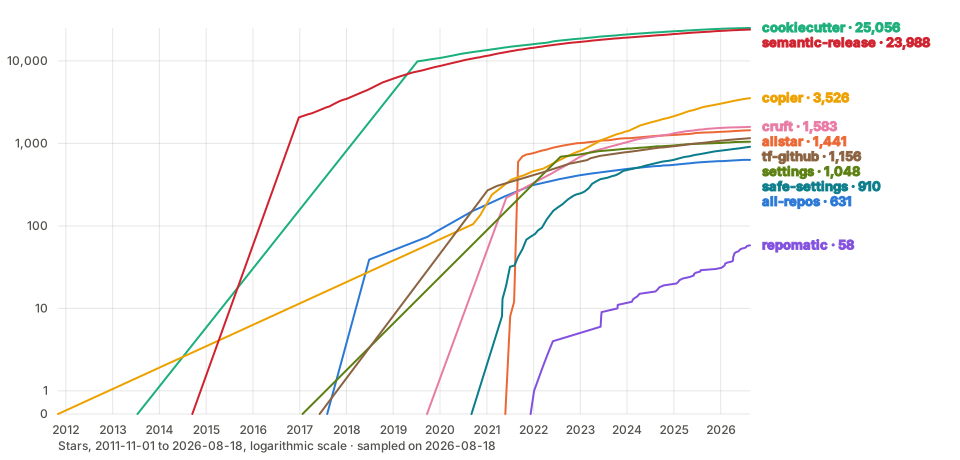
The vertical axis counts by powers of ten. The largest alternative here holds two orders of magnitude more stars than repomatic, and a linear axis draws every other project flat along the bottom edge.
GitHub restricted its stargazer endpoints to a repository’s own admins in June 2026, which left every third-party star chart on the web rendering an error card. It reopened an anonymous star history in September. repomatic sample-metrics reads every project on this page every quarter into metrics.csv, so the history accrues here and cannot be revoked a second time.
Every curve is reconstructed from the stars its repository still holds, dated to the week each was given, and runs back to that repository’s creation. So a curve understates every past week by the stars withdrawn since, and converges on the true figure at the right edge: read a sagging stretch as a project shedding followers, which a monotonic chart would hide. The star counts below are live in every case. See History for repomatic’s own curve on its own scale.


Distribution


Metadata
Metadata |
|
|
|
|
|
|
|
|
|
|---|---|---|---|---|---|---|---|---|---|
License |
|||||||||
Main language |
Python |
Python |
JavaScript |
Python |
Go |
Go |
JavaScript |
JavaScript |
Python |
Deployment model |
CLI |
CLI, library |
CLI (Node.js) |
CLI, library |
Self-hosted GitHub App |
Terraform provider |
GitHub App |
GitHub App |
CLI |
Configuration |
|
|
|
|
|
|
|
|
|
Benchmark date |
2026-11-03 |
2026-11-03 |
2026-11-03 |
2026-11-03 |
2026-11-03 |
2026-11-03 |
2026-11-03 |
2026-11-03 |
2026-11-03 |


Excluded projects
Note
cruft (about 1,600 stars) is not included because it has had no commit since its 2.16.0 release on 2024-12-25. cruft/cruft#343, which asks about the future of the project, is still open.